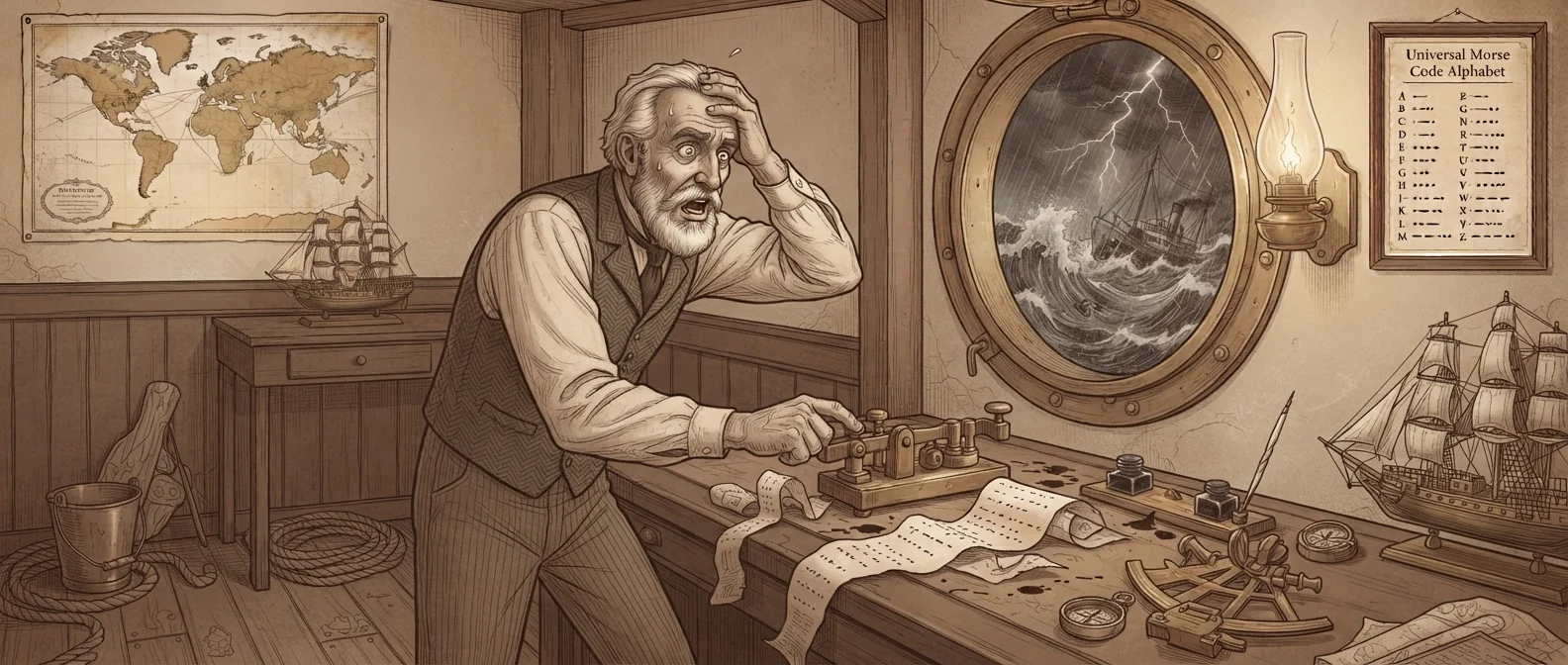
How to Write SOS in Morse Code
SOS is the most recognized Morse code signal in the world. It consists of three short signals (dots), three long signals (dashes), and three more short signals:
· · · — — — · · ·
Unlike most Morse code, SOS is sent as a single continuous signal without pauses between letters. This makes it unmistakable and faster to transmit in emergencies.
To send SOS:
- Send three quick, short signals (dit-dit-dit)
- Immediately follow with three longer signals (dah-dah-dah)
- Finish with three more quick signals (dit-dit-dit)
- Pause, then repeat
The entire sequence should take about 3 seconds to transmit at standard speed.
What to Know Before You Use It
SOS is internationally recognized as a distress signal. Using it falsely is illegal in most countries and can result in serious penalties. Reserve SOS for genuine life-threatening emergencies where you need immediate rescue assistance.
When to use SOS:
- You’re stranded and need rescue
- There’s a medical emergency with no other way to call for help
- Your life or someone else’s life is in immediate danger
- You’re lost in wilderness without cell service
How SOS can be signaled:
- Sound: Whistle, horn, or shouting the pattern
- Light: Flashlight, mirror, or fire (three short flashes, three long, three short)
- Visual: Waving arms or fabric in the pattern
- Physical: Tapping on a surface or wall
Breakdown of Each Letter
| Letter | Morse Code | Pronunciation |
|---|---|---|
| S | · · · | dit-dit-dit |
| O | — — — | dah-dah-dah |
| S | · · · | dit-dit-dit |
Timing guide:
- A dot (·) is 1 unit of time
- A dash (—) is 3 units of time
- Space between signals within a letter: 1 unit
- SOS is sent without spaces between letters (prosign)
Common Mistakes to Avoid
-
Adding pauses between letters: SOS should flow as one continuous signal, not “S” pause “O” pause “S”
-
Rushing the dashes: Each dash should be clearly three times longer than a dot. Rushed dashes sound like dots.
-
Inconsistent spacing: Keep your rhythm steady. Practice with a metronome if needed.
-
Not repeating: In an emergency, send SOS repeatedly with a short pause between sequences. Don’t send it just once.
-
Confusing with other signals: Make sure you know the difference between SOS and other patterns like “OK” (— — — / — · —).
Frequently Asked Questions
What does SOS stand for?
Contrary to popular belief, SOS doesn’t stand for “Save Our Souls” or “Save Our Ship.” It was chosen in 1906 simply because the pattern (· · · — — — · · ·) is easy to recognize and transmit. The letters themselves are meaningless—it’s purely about the distinctive rhythm.
Why was SOS chosen as the distress signal?
Before SOS, different countries used different distress signals, causing confusion. At the 1906 International Radiotelegraph Convention in Berlin, SOS was adopted because:
- It’s simple to remember and send
- It’s distinctive and hard to confuse with other signals
- It can be sent quickly, even by inexperienced operators
- It’s recognizable even through static and interference
How do I signal SOS with a flashlight?
Point your flashlight toward potential rescuers and flash:
- Three quick flashes (on-off-on-off-on-off)
- Three slow flashes (on…off…on…off…on…off)
- Three quick flashes again
- Pause for a few seconds
- Repeat
Each quick flash should be about half a second. Each slow flash should be about 1.5 seconds.
Can I use SOS if I’m not on a ship?
Yes. While SOS originated in maritime communication, it’s now universally recognized for any emergency situation—on land, at sea, or in the air. Hikers, pilots, and anyone in distress can use SOS to signal for help.
What replaced SOS in modern maritime communication?
In 1999, the Global Maritime Distress and Safety System (GMDSS) became the primary method for maritime distress calls, using satellite and digital technology. However, SOS remains universally recognized and is still taught as an emergency backup signal.