Morsecode Alphabet
Vollständige Morsecode-Alphabet-Tabelle mit Audio. Lernen Sie Buchstaben A-Z, Zahlen 0-9 und Satzzeichen im internationalen Morsecode.
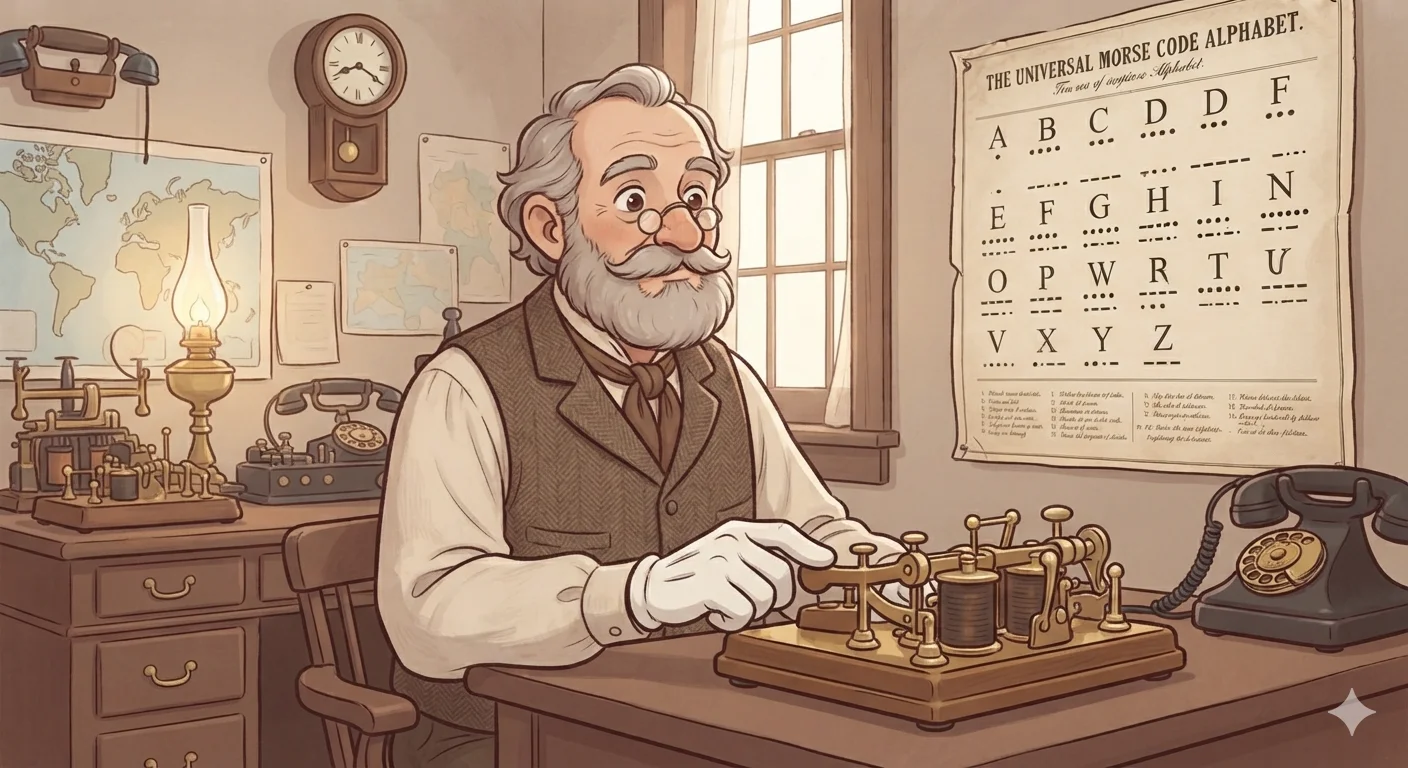
The International Morse Code encodes the 26 English letters A–Z, the digits 0–9, and a small set of punctuation and procedural signals. Each character is represented by a unique sequence of short signals (dots, ·) and long signals (dashes, —). A dot is one unit of time; a dash is three units. The space between parts of the same letter is one unit, between letters is three units, and between words is seven units.
Tip: Click any character below to hear its Morse code sound.
Buchstaben
Zahlen
Satzzeichen
Prosigns
Complete Morse Code Reference
| Char | Morse Code | Sound | Memory Cue | Actions |
|---|---|---|---|---|
| Letters (A-Z) | ||||
| A | di-DAH | a-PART (short-long) | ||
| B | DAH-di-di-dit | BOOT-to-the-head (B starts with dash) | ||
| C | DAH-di-DAH-dit | CO-ca-CO-la | ||
| D | DAH-di-dit | DOG-did-it | ||
| E | dit | Simplest letter - just one dot! | ||
| F | di-di-DAH-dit | did-i-FAIL-it | ||
| G | DAH-DAH-dit | GOOD-GOOD-grief (two dashes like spectacles) | ||
| H | di-di-di-dit | ha-ha-ha-ha (4 short laughs) | ||
| I | di-dit | Two dots like the two eyes above "i" | ||
| J | di-DAH-DAH-DAH | ju-NI-OR-MISS (J hooks down = long tail) | ||
| K | DAH-di-DAH | KANG-a-ROO | ||
| L | di-DAH-di-dit | to-DAY-we-learn | ||
| M | DAH-DAH | Two dashes like two humps of M | ||
| N | DAH-dit | Opposite of A (NAH vs Ah) | ||
| O | DAH-DAH-DAH | Three dashes - round like O | ||
| P | di-DAH-DAH-dit | pa-PAA-PA (papa) | ||
| Q | DAH-DAH-di-DAH | GOD-SAVE-the-QUEEN | ||
| R | di-DAH-dit | ro-DAY-o (rodeo) | ||
| S | di-di-dit | Three dots like a snake's hiss: sss | ||
| T | DAH | Single dash - tall like T | ||
| U | di-di-DAH | u-ni-VERSE (up at the end like U shape) | ||
| V | di-di-di-DAH | Beethoven's 5th: da-da-da-DUM (Victory!) | ||
| W | di-DAH-DAH | a-WORLD-WAR (W = double-U = two dahs) | ||
| X | DAH-di-di-DAH | X marks the SPOT it (dash-dot-dot-dash) | ||
| Y | DAH-di-DAH-DAH | WHY-did-I-CRY | ||
| Z | DAH-DAH-di-dit | ZINC-ZOO-key (starts with two dashes like Z has two horizontal lines) | ||
| Numbers (0-9) | ||||
| 1 | di-DAH-DAH-DAH-DAH | One dot then four dashes (1 dot = 1) | ||
| 2 | di-di-DAH-DAH-DAH | Two dots then three dashes (2 dots = 2) | ||
| 3 | di-di-di-DAH-DAH | Three dots then two dashes (3 dots = 3) | ||
| 4 | di-di-di-di-DAH | Four dots then one dash (4 dots = 4) | ||
| 5 | di-di-di-di-dit | All five dots (5 dots = 5) | ||
| 6 | DAH-di-di-di-dit | One dash then four dots (starts the reverse) | ||
| 7 | DAH-DAH-di-di-dit | Two dashes then three dots | ||
| 8 | DAH-DAH-DAH-di-dit | Three dashes then two dots | ||
| 9 | DAH-DAH-DAH-DAH-dit | Four dashes then one dot | ||
| 0 | DAH-DAH-DAH-DAH-DAH | All five dashes (opposite of 5) | ||
Hover over rows to see speaker and copy buttons. Click the info icon next to memory cues to learn about morse code patterns.
Fun Facts About Morse Code
Morse code is full of clever design choices and fascinating history. Here are some patterns and facts that make learning easier.
Numbers Follow a Perfect Pattern
Numbers 1-5 use progressively fewer dashes (4→0), while 6-0 use progressively fewer dots (4→0). The number of dots in 1-5 equals the digit itself!
1 = .---- (1 dot), 2 = ..--- (2 dots), ..., 5 = ..... (5 dots)E is the Most Common, So It's the Shortest
Samuel Morse analyzed letter frequency in English. "E" appears most often (~13% of letters), so he assigned it the shortest code: a single dot. "T" is second most common, getting a single dash.
E = · (1 element) vs. Z = --.. (4 elements)SOS Wasn't Chosen for Its Meaning
The famous SOS distress signal (···---···) wasn't an acronym for "Save Our Souls." It was chosen in 1906 because the pattern is unmistakable and easy to send. The letters just happen to form SOS.
SOS = ···---··· (continuous, no letter spacing)Mirror Letter Pairs
Several letters are exact mirrors of each other: A (·—) and N (—·), U (··—) and D (—··), K (—·—) and R (·—·). This wasn't intentional but helps with memorization.
A (·—) ↔ N (—·) are inversesThe "All Dots" and "All Dashes" Groups
Only 4 letters use exclusively dots (E, I, S, H) and only 3 use exclusively dashes (T, M, O). These are often the easiest to learn first.
H = ···· (4 dots), O = --- (3 dashes)Morse Code is Still Faster Than Texting
Expert Morse operators can send 40+ words per minute. The world record is 75 WPM. Many amateur radio operators still prefer Morse for weak signal conditions.
A skilled operator sends ~200 characters per minuteBeethoven's Fifth = V for Victory
During WWII, the BBC used the opening of Beethoven's Fifth Symphony (da-da-da-DUM) as its call sign because it matches V (···—) in Morse - V for Victory.
V = ···— = ♩♩♩♩ (Beethoven's 5th opening)Morse Persists in Unlikely Places
Aviation navigation beacons (VOR/NDB) still identify themselves with Morse code. Even modern car horns playing tunes sometimes embed Morse messages in the rhythm.
Airport VOR signals transmit their 3-letter ID in MorseSome Characters Share the Same Code
While all 26 letters and 10 digits have unique codes, some prosigns (procedural signals) share codes with punctuation. For example, + and <AR> (end of message) both use ·−·−· The difference? Prosigns are sent without spaces between the elements, making them distinct in practice.
+ = ·−·−· and <AR> = ·−·−· (sent as one unit)How to Learn the Morse Code Alphabet
Learning Morse code is easier when you break it into small groups and practice regularly. Here are proven techniques:
1. Start with Common Letters
Begin with the most frequently used letters in English: E, T, A, O, I, N. Conveniently, E (·) and T (—) are the simplest codes—just one symbol each. Master these six letters first, and you'll be able to decode a significant portion of English text.
2. Use Mnemonics
Memory aids help associate letters with their patterns:
- A (·—) — "a-PART" (short-long)
- B (—···) — "BOOT-to-the-head" (long-short-short-short)
- C (—·—·) — "CO-ca-CO-la"
- M (——) — Two dashes, like the two humps of "M"
- O (———) — Three dashes, round like "O"
- S (···) — Three dots, like a snake's hiss
3. Learn by Sound, Not Sight
Morse code is fundamentally an audio language. Instead of memorizing dot-dash patterns visually, learn the rhythm of each letter. Listen to the sound "di-dah" for A, not "dot-dash." This builds faster recognition when receiving code.
4. Practice with the Koch Method
The Koch method starts by learning two characters at full speed (20+ WPM). Once you achieve 90% accuracy, add one more character. This prevents the bad habit of counting dots and dashes and builds instant recognition.
5. Use Flashcards and Daily Practice
Even 10–15 minutes daily is more effective than occasional long sessions. Use our translator to practice encoding and decoding messages, gradually increasing speed as you improve.
History of the Morse Code Alphabet
Samuel F.B. Morse and Alfred Vail developed Morse code in the 1830s–1840s for use with the electric telegraph. The original "American Morse Code" assigned codes based on letter frequency in English—E got the shortest code (a single dot) because it's the most common letter.
In 1865, the International Morse Code was standardized at the International Telegraphy Congress in Paris. This version simplified some patterns and became the worldwide standard. It remains in use today for amateur radio, aviation, and emergency signaling.
Though modern digital communication has largely replaced telegraphy, Morse code persists because it's simple, requires minimal equipment, and can be transmitted by sound, light, or touch—making it invaluable in emergencies when other communication fails.
Frequently Asked Questions
What is the easiest letter to learn in Morse code?
E (·) and T (—) are the easiest—just one dot and one dash respectively. They're also the most common letters in English, so you'll use them constantly.
How long does it take to learn the Morse code alphabet?
With consistent daily practice (15–30 minutes), most people can learn all 26 letters in 2–4 weeks. Reaching proficiency at 15–20 words per minute typically takes 2–3 months.
Why are some Morse codes longer than others?
Morse and Vail designed the code for efficiency. Common letters like E, T, A, I get short codes (1–2 symbols), while rare letters like Q, X, Z get longer codes (4 symbols). This minimizes average transmission time.
Is Morse code still used today?
Yes. Amateur radio operators use it worldwide. Aviation navigation aids (VORs, NDBs) identify themselves in Morse. It's also used in accessibility devices for people who can't speak or type, and remains a backup emergency signal.
Are there any characters that share the same Morse code?
All 26 letters (A-Z) and 10 digits (0-9) have unique Morse codes—no two share the same pattern. However, some prosigns (procedural signals) share codes with punctuation marks. For example, the plus sign (+) and the prosign <AR> (end of message) both use ·−·−·. The difference is that prosigns are transmitted as a single unit without inter-character spacing, making them distinct in practice. Similarly, the equals sign (=) shares its code with <BT> (break/pause).